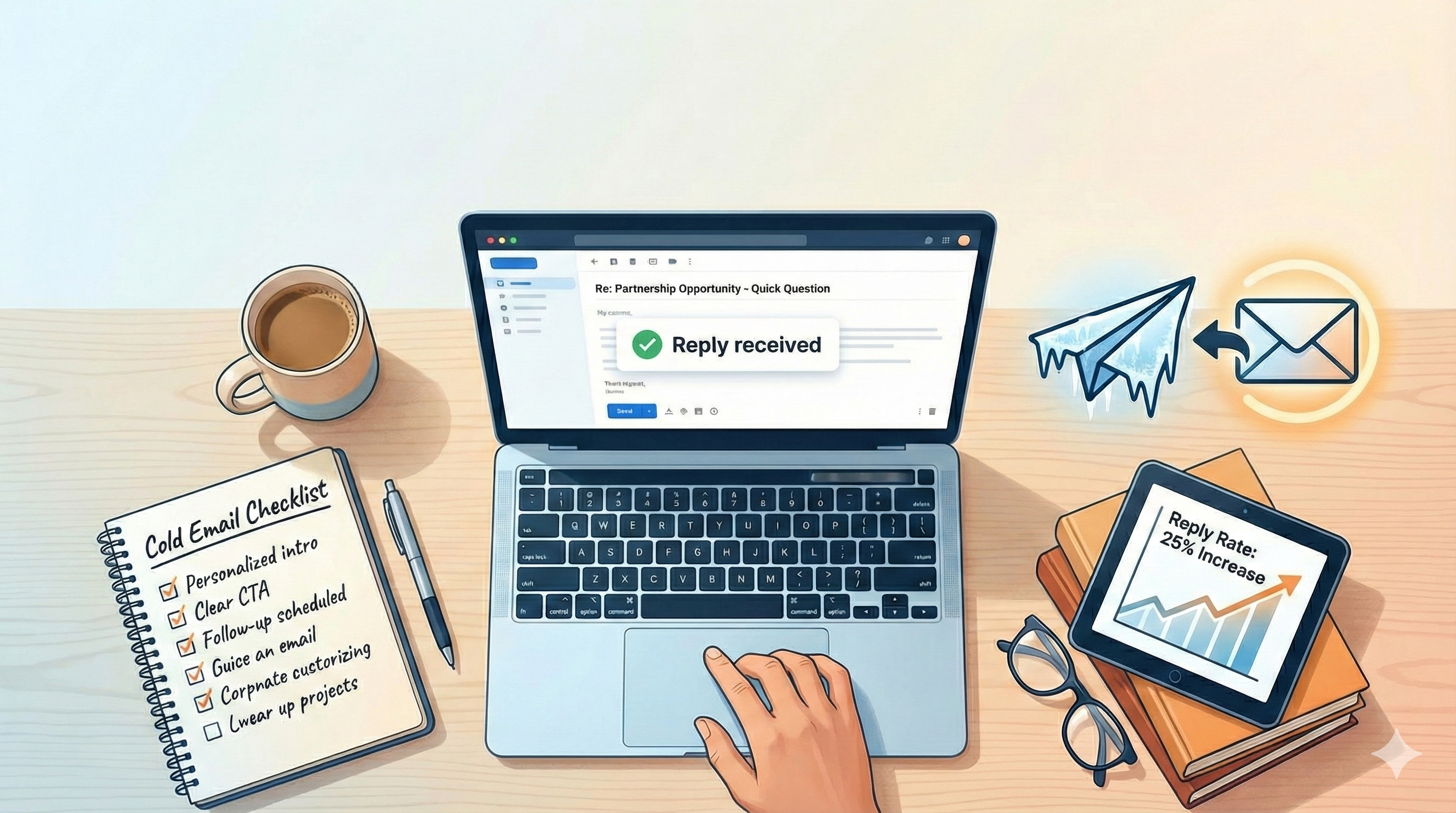
Cold emailing is not dead. In fact, it's one of the most powerful tools for growing a business—when done right. The problem is that most cold emails are terrible. They're generic, self-centered, and give the recipient zero reason to respond.
In this comprehensive guide, we'll break down exactly what separates emails that get 2% response rates from those that achieve 40%+. Whether you're a freelancer looking for clients, a founder seeking partnerships, or a sales professional building your pipeline, these principles will transform your outreach.
Why Most Cold Emails Fail
Before we dive into what works, let's understand why most cold emails end up in the trash. After analyzing thousands of cold emails, we've identified the three deadly sins:
- The "Me, Me, Me" syndrome: Starting with "I'm reaching out because..." or immediately talking about your company. The recipient doesn't care about you yet.
- Generic templates: Using the same email for everyone. People can smell a template from miles away, and it signals that you don't value their time enough to personalize.
- No clear value proposition: Failing to answer the critical question: "What's in it for me?"
The best cold emails don't feel like cold emails at all. They feel like a warm introduction from someone who genuinely understands your business and has something valuable to offer.
The WARM Framework for Cold Emails
We've developed a framework called WARM that consistently produces high-converting cold emails. Here's how it works:
W — Why Them
Start by explaining why you're reaching out to this specific person at this specific company. This demonstrates that you've done your research and aren't just blasting emails to a list.
"I noticed you just raised your Series A—congratulations! Looking at your roadmap, it seems like scaling your engineering team is a priority for Q1..."
This opening immediately signals that you understand their world. It creates a connection before you've even made your pitch.
A — Acknowledge Their Challenge
Show that you understand a specific challenge they're likely facing. This builds credibility and positions you as someone who "gets it."
The key here is specificity. Don't say "I know growing a business is hard." Instead, say "Hiring senior engineers in the fintech space is incredibly competitive right now, especially with companies like Stripe and Plaid snapping up top talent."
R — Reveal Your Solution
Now—and only now—do you talk about yourself. But frame it in terms of their problem, not your product.
- ❌ "We're an AI-powered email platform with advanced personalization features."
- ✅ "We help teams like yours send personalized outreach at scale—turning cold prospects into warm conversations without the manual research."
M — Make It Easy to Say Yes
Your call-to-action should be low-friction. Don't ask for a 30-minute call in your first email. Instead, ask for permission to share more, or propose a specific next step that requires minimal commitment.
Good examples:
- "Would it be helpful if I shared a quick case study of how we helped [similar company]?"
- "Do you have 10 minutes this week for a quick call to see if this might be valuable for [company name]?"
- "Mind if I send over a personalized video showing what this could look like for you?"
The Science of Subject Lines
Your subject line determines whether your email gets opened. After testing over 10,000 subject lines, here's what we've learned:
- Keep it short: 4-7 words perform best. Mobile previews cut off longer subjects.
- Personalize when possible: Including the company name increases open rates by 22%.
- Create curiosity: But avoid clickbait. The goal is relevance, not deception.
- Lowercase works: All-lowercase subject lines feel more personal and less like marketing.
Examples that work:
quick question about [company name]
idea for your outreach
[mutual connection] suggested I reach out
saw your post on [topic]
Personalization at Scale
The biggest objection to personalized cold emails is time. "I can't spend 20 minutes researching every prospect." You're right—you can't. But you don't have to.
Here's our 60-second research method:
- LinkedIn (20 seconds): Check their role, recent posts, and company news.
- Company website (20 seconds): Skim the homepage and about page for positioning and recent updates.
- Google News (20 seconds): Search "[company name] news" for recent press, funding, or announcements.
With practice, this becomes second nature. You'll find a personalization hook in almost every case.
Tools like WarmLeads can automate the research phase, analyzing company websites and generating personalized email drafts in seconds. This lets you focus on refining the message rather than digging for information.
Timing Your Emails
When you send matters almost as much as what you send. Our data shows:
- Best days: Tuesday, Wednesday, and Thursday outperform Monday and Friday by 23%.
- Best times: 8-10 AM and 4-6 PM in the recipient's time zone.
- Avoid: Weekends and holidays (unless targeting founders who work non-stop).
But remember: the best time to send is when your email is ready and good. Don't let timing become an excuse for procrastination.
The Follow-Up Sequence
80% of sales require at least 5 follow-ups, but 44% of salespeople give up after just one email. Don't be that person.
Here's a follow-up sequence that works:
- Day 1: Initial email
- Day 3: Quick bump ("Just wanted to make sure this didn't get buried...")
- Day 7: Add value (share a relevant article, insight, or case study)
- Day 14: New angle (try a different hook or benefit)
- Day 28: Break-up email ("I'll assume the timing isn't right...")
Each follow-up should add something new—never just "checking in" with nothing to offer.
Putting It All Together
Let's look at a complete example using everything we've covered:
Subject: quick thought on [company name]'s outreach

Hi Sarah,

Congrats on the Series A—exciting times at [company name]!
I noticed you're scaling the sales team, which usually means
outreach volume is about to spike.

One challenge I see teams face at this stage: maintaining
personalization as you scale. Generic emails kill reply rates,
but researching 100 prospects a day isn't realistic.

We've helped teams like [similar company] increase reply rates
by 3x while cutting research time by 80%. Happy to share a
quick case study if useful.

Either way, wishing you a strong Q1.

Best,
Alex
Notice how this email:
- Opens with something specific about them
- Identifies a relevant challenge
- Offers proof without being salesy
- Ends with a low-friction ask
Final Thoughts
Cold emailing is both an art and a science. The science is in the frameworks, timing, and testing. The art is in the empathy—truly understanding the person on the other end and crafting a message that resonates with their world.
Start implementing these strategies today. Test, iterate, and refine. Your reply rates will thank you.
Want to supercharge your cold outreach? Join the WarmLeads waitlist and be the first to turn any website into a warm, personalized email.